


But it's no Halloween joke. Investigators say the human heads had been used for medical training in the Fort Worth area and were being returned to Little Rock, Arkansas. Hunt County Justice of the Peace Aaron Williams was summoned during a traffic stop Sunday in Royse City after a trucker was suspected of speeding.
The wrapped-in-plastic heads were found in the trailer. The driver couldn't immediately locate the documentation.
The trucker and his cargo were later allowed to proceed after the paperwork was faxed to him. The name of the company wasn't immediately released. (Source http://www.dallasnews.com/)
Showing posts with label embalmed. Show all posts
Showing posts with label embalmed. Show all posts
Tuesday, October 30, 2007

Wednesday, September 26, 2007
Few Civil War Soliders Were Embalmed... Did you know?
Interesting story in the September 10th, 2007 edition of the Washington Times, about how few Civil War Soldiers were embalmed.
According to James Lowry a historian, author and professional embalmer out of Charleston, W. VA; of the roughly 620,000 soldiers killed from 1861 to 1865 during the war, only 40,000 were injected with chemicals to preserve their remains. The two factors determining whether you would be preserved were a) money, and b) condition of the body. "Most soldiers were buried where they fell," according to Lowry.
The National Museum of Civil War Medicine in downtown Frederick, MD has a permanent exhibit on embalming which flourished during the war as family members sought to have their loved ones bodies returned home for burial which could take days. "The body has to be free of odor before they would ship it and if a corpse started stinking in transit, workers removed it from the train and buried it at the next train stop."
As soldiers went off to battle, some embalmers handed them fliers encouraging them to prepay for their embalming at rates up to $100.00 according the the museum records. Those who accepted were given cards to carry as proof of purchase, specifying their burial wishes. According to Lowry, this practice was eventually barred because it hurt troop morale. Instead, embalmers followed the battles and picked through he dead to find officers, whose families were likely to be wealthy enough to pay for embalming.

The embalmers were generally doctors who learned about chemical preservation for human tissue in medical school. Whole body preservation gained widespread acceptance with he embalming of Col. Elmer E. Ellsworth a Friend of President Lincoln and leader of the 11th New York Zouave Regiment who was among the first to die for the Union. Ellsworth was shot May 24, 1861 after removing a Confederate flag from atop the Marshall House Inn in Alexandria, VA
Lincoln had Ellsworth's body bought to the White House where it laid in state for a day before being moved to City Hall in New York. Ellworth was buried in Mechanicsville, N.Y. 10 days after his death, and was in very good condition at the time of his burial.
During the war, embalers used arsenic, alcohol, zinc chloride and other chemicals to preserve bodies because formaldehyde had not been discovered yet.
Lowry said that one of the wars best known embalmers was Dr. Richard Burr who worked out of a tent at the Battle of Gettysburg and out of the building that now houses the Civil War Medicine Museum during the battles of Antietam, South Mountain and Monocacy.
Tuesday, October 31, 2006
A Little Halloween Humor : )
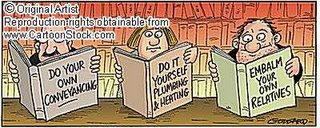
Do your own conveyancing...Do it yourself plumbing and heating...Embalm your own relatives.
Found here
Tuesday, October 10, 2006
Eco Friendly Cardboard Coffins
When a arranging a funeral for a close relative or friend, or just making funeral plans for the future, the thought of spending a significant sum on a traditional coffin may seem to be at odds with ‘the way they lived their life’ or to be incompatible with the environmental ethics that they tried to uphold.
A Cardboard Coffin may be the ideal solution to the problem and can be bought for use in Woodland cemeteries, Green burials, environmentally friendly funerals, or for an alternative funeral where an individual request may include a painted coffin. And, they can be purchased online . . .
A Cardboard Coffin may be the ideal solution to the problem and can be bought for use in Woodland cemeteries, Green burials, environmentally friendly funerals, or for an alternative funeral where an individual request may include a painted coffin. And, they can be purchased online . . .
Subscribe to:
Posts (Atom)

