Thursday, January 04, 2007

Green Beret Killed in Iraq Throws 100K Vegas Party for Friends


"I died doing something I believed in, and have no regrets,
except that I couldn't do more"
Captian Jeffrey Toczylowski

This is a wonderful story (found here)


Captain Jeffrey Toczylowski, 30 years old. RIPHis friends have set up a tribute website. Check out “Party Toz,” at least.

LAS VEGAS — Shortly after Jeffrey "Toz" Toczylowski's last mission in Iraq a year ago this month, friends received a message. "If you are getting this e-mail, it means that I have passed away," the missive said. "No, it's not a sick Toz joke, but a letter I wanted to write in case this happened." The Army Special Forces captain, 30, said he would like family and friends to attend his burial at Arlington National Cemetery, "but understand if you can't make it."

The message, distributed by a fellow Green Beret after Toczylowski's family had been notified of his death, added: "There will also be a party in Vegas with a 100k to help pay for travel, room and a party."

Last Saturday, Toczylowski's mother, Peggy, hustled about Las Vegas' Palms Hotel and Casino, making final arrangements for a bash that drew family and childhood friends from her son's hometown in Upper Moreland, Pa., near Philadelphia, men and women from his days at Texas A&M University, and comrades in arms who had bonded with "Toz" on missions they could not discuss with civilians.

By 7 p.m., the last of 120 or so guests were offering hotel bouncers the password and trooping into the Palm's 10,000-square-foot Hardwood entertainment suite.Two women in skimpy outfits poured liquor from the fully stocked bar. Disc jockeys blasted rock and rap from a loft decked out with a pool table, a wide-screen video-game console and a circular loveseat with remote controls that rotated it out of view.

At 9 p.m., six Green Berets swarmed an unsuspecting colleague on the suite's attached basketball court. A few feet from where one chef carved rare prime rib and a sushi chef sliced young yellowtail and spicy tuna rolls, the men wrestled their thrashing comrade onto an 8-foot stepladder, secured him from chin to shoes with a few hundred feet of duct tape, covered him with whipped cream and strategically placed cherries, spray-painted his hair red, poured whiskey down his throat and then hoisted the ladder into a vertical position and stuck a microphone to his face.

"The first time this happened we were in Bosnia," said detachment leader Ryan Armstrong, 31, spitting booze and dessert toppings. "Jeff was a sniper-team leader. I was the assault-team leader. ... That time they left me taped to a dolly for a couple of hours. ... Toz was the one who cut me loose."

A limbo contest erupted. With help from soldiers from the Special Forces base near Stuttgart, Germany, a full-size cutout of Toczylowski in red flight suit appeared to hold the pole while a long line of partygoers wobbled underneath. Around midnight, the Toz cutout — wearing a Russian fur cap with goofy earflaps — joined in the dance contest, wriggling between couples to show off moves of dubious propriety. Inspired by this boldness, several former girlfriends danced suggestively with the photo.

Bittersweet night

At 3 a.m., music still thudded, guests were hurling basketballs at the hoop (the three Murphy beds in the court's walls had yet to be unfolded) and the Toz cutout hovered over the suite's glass-enclosed Jacuzzi, as if gawking at the whooping, squealing stew of young women and soldiers.

Toz's mother had placed photos of the missing host — hoisting a big fish, grinning beside a waterfall, posing with his motorcycle — near the gurgling chocolate fountain, around the pasta station and throughout the opulent bedrooms and baths.

Likewise, although most of the wall-mounted flat-screen TVs aired football games, the main room's largest screen featured home videos Toz's sister Pam, 34, had assembled. Early in the evening, the footage was of Toczylowski as a child, frolicking in the snow, helping his father build a backyard swimming pool, playing football and soccer. As the night wore on, the young man went skydiving across the screen, ran with the bulls in Spain and helped lock a friend in an outhouse at a car race.

Peggy, 55, had wanted all the images to be joyful. But well past midnight, someone put in a more current DVD. Tracer bullets streaked across the Iraq sky. Buildings exploded in fireballs. And there was Toz, crammed into a helicopter with Special Forces comrades. A soldier who had served on Toczylowski's 12-man A-team was making seductive overtures to an A&M alum when the screen filled with footage of his teammate's memorial service at a dusty base in Iraq. Taps sounded. The Green Beret turned away, weeping. Off and on, Peggy Toczylowski got teary, too.

A manager at a Pennsylvania design studio, she was in her office on Nov. 4, 2005, when three uniformed soldiers came to inform her that her son had been killed on a combat mission in Iraq's Anbar province. A few weeks after her son's Nov. 14 burial at Arlington, a team of Special Forces soldiers arrived at her home and gave an hourlong PowerPoint presentation on the details.

"No regrets"

On Nov. 3, a string of Blackhawk helicopters had been roaring across the desert on a nighttime counterinsurgency raid, carrying Special Forces soldiers to hunt high-value targets who had been making improvised explosive devices. Flying over the desert at night is disorienting. Toz apparently believed the helicopter had touched down. He stepped out. It was more than 100 feet off the ground and thundering ahead at 100 mph.

His mother was impressed with the professionalism of the Army's presentation and took comfort in learning that the mission had been a success. Her son's e-mail precluded any resentment. "Don't ever think that you are defending me by slamming the Global War on Terrorism or the U.S. goals in that war," Jeffrey Toczylowski wrote. "As far as I am concerned, we can send guys like me to go after them or we can wait for them to come back to us again. I died doing something I believed in and have no regrets except that I couldn't do more."
Toczylowski had gone through the Reserve Officers' Training Corps at Pennsylvania's Valley Forge Military College and then turned his Texas A&M criminal-justice degree into an assignment as platoon leader with the military police. He had completed the Special Forces training course in 2003.

After a sergeant in his company died of a heart attack, Toczylowski got serious about his mortality, fellow soldiers said. He earmarked money from his savings and insurance policies to assist friends and help cousins with college tuition and to fund a scholarship at Valley Forge, his mother said.

Honoring his wishes


The party was the challenge for the family. But Peggy and Pam say Toczylowski was wise, and they're convinced he knew that assigning them planning duties would keep their minds off losing a son and brother. By the time a waiter pushed through the door of the suite with a breakfast cart full of juices and pastries, Pam Toczylowski ventured to guess that the party probably would come in just under $100,000, including airfare and rooms for her brother's teammates and a few friends who otherwise might not have been able to attend. She said it was worth it.
"Jeff was the kind of person who lived every day as if it would be his last," Pam said. And he would want them to make his farewell bash "a party that when people leave, they will talk about it forever."

(Sources: Seattle Times, Tribute Website and PS Board)

Wednesday, January 03, 2007

Found ... the perfect Coffin for the Basket Lover


Seriously. Beautiful coffins... a basket lovers dream. The Wicker Coffin put out by The Somerset Willow Company Limited. Really gorgeous and definitely eco-friendly.

The Hill family of Somerset have made traditional willow basket ware for over 45 years, employing 13 key staff, including 9 fully trained basket makers who complete a minimum 5 year training process. Their belief is that the willow coffins are the ultimate consideration towards environmental recycling. This is because willow grows up to 8ft in height in one year and because it grows from the same crown annually, it doesn’t need to be replanted each time it is harvested. Willow requires little mechanical processing, making it one of the few truly environmentally renewable resources. In addition, willow when buried under the ground decomposes far more quickly compared to hard woods. (isn't that cool~~~~) Take a peek at their website to view their work ... it's beautiful.

I don't know why but when I came across this it seriously reminded me of the old movie "Ten Commandments" with Charleton Heston; in the beginning when they float baby Moses down the river in the basket. I just think these are beautiful!

Contact them Call: 01278 424003Fax: 01278 446415

The Wireworks EstateBristol RoadBridgwaterSomerset TA6 4APE mail enquiries@somersetwillow.co.uk

Friday, December 22, 2006

Find A Grave

Can't help it... I am in to movie stars, celebrities, heroes and people who are noted for making a difference in this world ... physicians, nobel peace prize winners, etc. And, I am always curious where they are laid to rest ...

There is a wonderful site if you are like me called "Find A Grave" where you can virtually (and I mean virtually) plug in a name and it will direct you to the persons grave site and additionally show you a picture and give you a short bio.

Lots of links on this site!

Tuesday, December 19, 2006

Embalmed to the Max Store ....

Okay.... we decided to create our own little Amazon Store: Embalmed to the Max : )

Our link is on the side. If you would like to visit .... it would make us happy : )

Corpus Obscurum

What a great blog: Corpus Obscurum .... Their logo ... "Remembering Those Whose Accomplishments Vastly Exceeded Their Fame."

So interesting whose on this blog! Read it and smile!

Friday, December 15, 2006

James Dean In Death


James Dean ....

This is an amazing site.... James Dean in Death. If you are into celebrity death curiousities, this is the spot for you. It has a little bit of everything:
  • A Blog .... P.S. Did you know that he has been dead almost 51 years??????
  • News stories
  • Pictures
  • and, so much more!
This site also offers a book on James Dean, his life, his death and the aftermath....

Interviews... like the following (found at this link)

The Death of James Dean: The Interviewwith Warren Beath...When did you write The Death of James Dean?

  • I started working on it in the early eighties but I had already been corresponding with accident investigators for ten years, and collecting things related to the accident. Were you just curious, or do you think the death of James Dean really was an important event?think it was an important event, occurring when it did right in the middle of the Twentieth Century. Dean was a unique sort of hero, and it took his death to authenticate him. A dramatic death is the validation of the existential hero and the savior of any religion. He has an incredible iconic importance to the culture. The image of Dean in his sports car has inspired all sorts of artists, and it continues to fascinate people.What are the facts of the accident?James Dean has a Porsche Spyder racer barely two weeks old and with between 600 and 800 miles on the odometer. He had entered an airport race in Salinas and it must have made him nervous, the idea of competing in that kind of car with no more seat time than he had in it. Because it was difficult to handle and that was a dangerous situation. I think that was another reason Rolf Weutherich, the German expert mechanic, was accompanying him to the race. To try and fill James Dean in on the handling of the car.That’s why they decided to drive the car rather than tow it?Yes. They left Los Angeles and James Dean was ticketed by officer O.V. Hunter at around three o’clock. Hunter told me that he believed Dean was going ninety miles an hour when he saw him, but slowed when he realized he was being pursued. Why didn’t he try to outrun the patrol car?(Laughing) He had apparently done that earlier in the week, pursued in the fog around Santa Barbara when he was practicing. But in this case Hunter would have radioed for help and more officers would have been waiting for Dean in Bakersfield, if he went through Bakersfield. For more, click here

Eco Caskets.... Natural and Earth Friendly


Now there is an environmental choice for those who prefer burial over cremation.The Eco Casket is a top notch solid oak casket crafted from materials that have a low environmental impact.By skillfully combining all natural materials and a high degree of craftsmanship, we've created a casket that will appeal to families who care for the environment, without compromising on quality, detail or esthetic appeal. Increasingly, families desire a funeral that is more meaningful and personal. A casket that reflects the personality and preferences of your loved one can be a beautiful tribute to their life. P.S. And, they have overnight delivery ...


Thursday, November 30, 2006

"Natural Burial Park" Means You Can Compost Yourself!

America's third "natural burial park, the Ethician Family Cemetery, has opened near Huntsville, TX. Biodegradable caskets, no steel vaults or embalming fluid allowed : )

So you ask, "What is an Ethician Cemetery?"

Ethician Cemeteries are "green cemeteries" where the Biblical philosophy of "dust to dust" is invoked.

So go ahead... this means you can compost yourself.

Wednesday, November 29, 2006

Roadside American Presents ... PET CEMETERIES

You heard it right .... on your next trip take some time to visit the pet cemeteries (not Stephen King's : ) ) Visit the Road Side American Presents Pet Cemeteries Site:

Great animals deserve post-mortem tributes as much as any President or rock star. It's unlikely you'll find Teddy Roosevelt's hide stretched over a frame and action-posed in a display case, but what about Trigger, Roy Roger's horse? Or Owney, the US Postal mascot dog? Or Old Rip, the desiccated miracle toad? You betcha. Americans adore their dead animal companions, if judged by the amount of stuffing and mounting, and of deified civic mascots and public statuary. Sometimes, it's just a worn granite slab and a sad story -- worthwhile enough for a snack-break off the interstate.

Noble Dog Mausoleum - Special pets, loyal and heroic.
Mascots - Representing and beloved by their towns and teams.
Pet Vets - Military pets. A posthumous salute to our furry finest.
Celebrities - Remnants and remembrances of the stars.
Behemoths - Immense giants, Nature's pets.
Elephant Burial Ground - Felled by mishap and misunderstanding.
Quarantine - Lonely rest for the contagious.
Faithful Steeds - Hero horses, happily ridden 'til they dropped.
Animal Magic - Special creatures; they know what you are thinking.

On your next vacation or road trip, plan on visiting at least one pet grave or animal memorial!

Tuesday, November 28, 2006

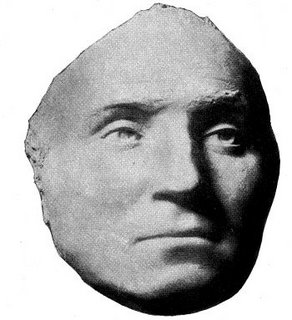
Great American Death Masks


Posted on Monday, April 26, 2004. “I shall secure him to a nicety if I am so fortunate as to get plaster enough for his carbuncled nose.” Originally from “A Collection of Death Masks,” Harper's New Monthly Magazine, vol. 85, iss. 510, October 1892. By Laurence Hutton.


Washington was as blessed in his death as in his life. He rests still upon the banks of the Potomac, among the people whom he so dearly loved, and among whom he died; and no later administration has ever cared to cut off his head[1] for exhibition on the roof of the Patent Office or the Smithsonian Institute.

At least two plaster casts were taken from the living face of Washington. The first, by Joseph Wright, in 1783, was broken by the nervous artist before it was yet dry; and the subject absolutely, and, it is whispered, profanely, refused to submit to the unpleasant operation again. The second was made by Houdon, the celebrated French sculptor, in 1785, and from it he modelled the familiar bust which bears his name.

The original Houdon mask of Washington is now in the possession of Mr. W. W. Story, in his studio in Rome. He traces it directly from Houdon's hands, and naturally he prizes it very highly. It has been preserved with great care, and of it he says that there is no question that “it was made from the living face of Washington, and that therefore it is the most absolutely authentic representation of the actual forms and features of his face that exists. In all respects, any portrait which materially differs from it must be wrong.” Mr. Story cannot account for the fact that the sculptor opened the eyes of Washington in the mask, except upon the supposition that he did not remain long enough at Mount Vernon to have studied and modelled the eyes for his bust from the face of Washington himself.

It is but just to add here that Mr. Story says that never, to his knowledge or belief, has a cast been made from the original which he owns. He examined the so-called cast in the Corcoran Gallery at Washington, and he was fully satisfied that, like all the other specimens in existence, it is of no value in itself, and was made from a wornout copy of the bust. The Washington here presented is from a photograph taken by Mr. Story in Rome, and from his own copy of the mask.

When Houdon came to America in 1785 to make the bust of Washington, he was the companion of Benjamin Franklin, and he was, in all probability, the author of this cast of Franklin's face, taken in Paris that year as a model for the well-known Houdon bust of Franklin, which it somewhat resembles. The original mask was sold for ten francs after the death of the artist in Paris in 1828.

The familiars of Franklin have shown that his face in his old age changed in a very marked degree. He was in his seventy-eighth or his seventy-ninth year when he sat for Houdon in 1784-5. Many of the features of the Franklin cast as here reproduced, the long square chin, the sinking just beneath the under lip, the shape of the nose, and the formation of the cheek-bones, are strongly preserved in the face of one of his great-granddaughters living in Philadelphia to-day.

Leigh Hunt in his Autobiography said that Franklin and Thomas Paine were frequently guests at the house of his maternal grandfather in Philadelphia when his mother was a girl. She remembered them both distinctly; and in her old age she told her son that while she had great affection and admiration for Franklin, Paine “had a countenance that inspired her with terror.” Hunt was inclined to attribute this in a great measure to Paine's political and religious views, both of them naturally obnoxious and shocking to the daughter of a Pennsylvania Tory and rigid churchman. Concerning the physical as well as the moral traits of the author of the Age of Reason, there seems to have been great diversity of opinion. To paraphrase the speech of Griffith in Henry VIII concerning Wolsey, He was uncleanly and sour to them that loved him not, but to those men that sought him, sweet and fragrant as summer.

His friend and biographer Clio Rickman, who considered him “a very superior character to Washington,” gave strong testimony to his personal attractions and tidiness of dress; while James Cheetham, his biographer and not his friend, told a very different and not a very pleasant story, in which soap and water ‒ or their absence ‒ play an important part. The former, according to Cheetham, was never employed externally by Paine, and the latter was very rarely, if ever, internally applied.

None of his earlier biographers give any hint as to the taking of this death-mask, nor is it to be found in any contemporary printed account of the death-bed scene. Experts agree that it is the face of Paine, and see in it a strong resemblance to the face in the Romney portrait, painted in 1792, seventeen years before Paine died. It was undoubtedly made after death, by John Wesley Jarvis, the painter, who was at one time an intimate of Paine's. He studied modelling in clay, and made the bust of Paine which is now in the possession of the Historical Society of New York.
Concerning this bust Dr. Francis, in his Old New York, wrote: “The plaster cast of the head and features of Paine, now preserved in the gallery of arts of the Historical Society, is remarkable for its fidelity to the original at the close of his life. Jarvis, the painter, then felt it his most successful work in that line of occupation, and I can confirm the opinion from my many opportunities of seeing Paine.” He added that Jarvis said, “I shall secure him to a nicety if I am so fortunate as to get plaster enough for his carbuncled nose,” which was not a very pretty speech to have made under any circumstances, particularly if the bust was a posthumous work.

Of Lincoln, as of Washington, two life-masks were made ‒ one in Chicago in the spring of 1860, by Mr. Leonard W. Volk, and here reproduced; one in Washington, by Mr. Clark Mills, about five years later.

Mr. Volk, in the Century Magazine for December, 1881, gives a pleasant account of the taking of the former. Mr. Lincoln sat naturally in the chair during the operation, watching in a mirror every move made by the sculptor, as the plaster was put on without interference with the eyesight or with the breathing of the victim. When, at the end of an hour, the mould was ready for removal ‒ it was in one piece, and contained both of the ears. Mr. Lincoln himself bent his head forward and worked it off gradually and gently, without injury of any kind, not withstanding the fact that it clung to the high cheek-bones, and that a few hairs on his eyebrows and temples were pulled out by the roots with the plaster.

This is, without question, the most perfect representation of Mr. Lincoln's face in existence. I have watched many an eye fill while looking at it for the first time; to many minds it has been a revelation; and I turn to it myself more quickly and often than to any of the others, when I want comfort and help.

Notes
1. cut off his head ‒ an allusion to Oliver Cromwell, whose body was exhumed in 1661, hung, drawn and quartered. The body was thrown into a pit, and the head displayed on a pole outside Westminster Abbey until 1685.

This is Great American Death Masks, an essay and a subject, originally from October 1892, published Monday, April 26, 2004. It is part of Death, which is part of Harper's Archive, which is part of Harpers.org.

RelatedFounding FathersNavigate by HierarchyPrev: [First in section]Next: A Child's First Impressions of Death

Up: Death Navigate by Time of PublicationPrev: Lingvo EurocraciaNext: Weekly Review
Permanent URLhttp://harpers.org/AmericanDeathMasks.html

Sunday, November 26, 2006

Clean Up in Frances Suicide Canyon Reveals Auto Graveyard

Tons of mangled cars piled up at the bottom of the Grand Canyon de Verdon in Provence are sombre evidence of France's high suicide rate. But on a brighter note, engineers now clearing the accumulated wreckage of 100 years are uncovering a veritable auto museum.

The Parc Régional du Verdon is a lush green landscape of deep canyons, thick vegetation and freshwater lakes. Located 90 km northeast of Aix-en-Provence in France's south-eastern Var district, the "Grand Canyon of Verdon" attracts one million nature-loving visitors each year. Unfortunately, some of them don't return. For decades, cars driven off the cliffs, some accidentally but many intentionally, have been piling up at the foot of the canyon.
It's a graveyard of old automobiles, some of them dating back to the 1930s. No one has bothered to it clean up -- until now. After two years of fund-raising, regional authorities recently completed the first two-week stage of a massive clean-up operation, lifting as much as 20 tonnes of debris out of the canyons.
Reason #1 Why you should drive slower in France ...

Extra Info:

Although it's much smaller than Arizona's Grand Canyon, the Gorges du Verdon is deep, compact, wild and beautiful. From Castellane to the village of Rougons, the Verdon river flows clear and swift, and the road follows along the banks. At Rougons, by the Point Sublime, the river plunges into the narrow rock walls, and there's no escape until it comes out the western end before flowing into Lac de Ste Croix.


Transportation

There isn't much in the way of public transportation in this area. The nearest train station is at Les Arcs (station Draguignan-Les Arcs). There are buses from Les Arcs to Draguignan and Aups.

History

The canyon was formed in the Quaternary Era, as a result of earth movements while the Alpes were "growing" upwards and from erosion of the Jurassic limestone by the Verdon river.
Through the 19th century, the deepest gorges were thought to be impenetrable. Only a few local woodcutters went down into the gorges on ropes, looking for box wood (buis) stumps that they used for making boules.

The canyon remained unexplored until the 20th century. Armand Janet attempted a canoe exploration in 1896, but gave up because of the violent currents. In August of 1905, the speleologist Edouard Alfred Martel did the first complete exploration of the gorges on a 3-day expedition. Part of the Martel trail is still used, between Point Sublime to La Maline.

Saturday, November 25, 2006

The American Dime Museum - Sideshows!


Ever been to the Dime Museum in Baltimore... if not you are missing a real treat. Remember the old carney stories, or reading the old dime novels when you were a kid ... well here is the real deal an actual museum that showcases side shows. Everything from the "Jackalope," the shrunken heads, mummies, and more...They are located in Baltimore, and I have had the pleasure of visiting this quirky, cool, museum. Housed in a small row house in old Baltimore, it's quirky, strange, unusual, incredibly amazing and well.... no other word to describe it .... "AMAZING." From their site, here is a true explanation of what they are all about:

Dime Museums & Sideshows - A Brief History

For as long as humanity has existed, there has been the desire to collect, especially to collect the strange, the unusual, the bizarre and the exotic. This drive led to the Cabinets of Wonder--collections of exotic objects gathered by wealthy and often eccentric Europeans prior to the 19th Century. These personal collections were the spiritual ancestors of the ultimate collections: the dime museums.

Though simply called museums in their early form, the idea of a collection of objects which the public would pay to see spread quickly in early 19th Century America. And by the mid-1800s, the idea had become so popular with the American public that entrepreneurial geniuses like P. T. Barnum became millionaires through the exhibition of vast collections of man-made and natural curiosities. Eventually, capitalizing on the public's need for entertainment of all types, museums came to house not only unique collections of objects; they also housed the first family-oriented performance spaces, menageries, and, in fact, nearly every type of entertainment available in 19th Century America. And all for only one dime.

Throughout the last days of the 19th Century and bulk of the 20th, carnivals roamed the American countryside as the circuses - the competition to the carnivals - had roamed the land since the late 1700s. In the days up to World War II, the carnivals were mostly shows - called the back end as that was the location of the shows on the typical carnival lot - with a ride or two thrown in among the concessions and games. The carnival shows grew from several traditions: The dime museums made famous by Barnum and the Peale family, with their fame in exhibiting the "wonders of nature, the works of man".

The traveling circuses, which showed that mobile entertainment could tap the resources of the exploding of population of a growing America.

The world's fairs, particularly the Columbian Exposition of 1893 in Chicago, where the grand Midway Plaisance and its multitude of amusements is credited with demonstrating to showmen that a gathering of their kind could make big money.

Even after the Second World War, when the writing was on the wall for the decline of the shows, there were still grand and glorious days for the back end, and there were still classic shows on the road into the '60s and early '70s.
Here is the link ... you can view some info on line....

Friday, November 24, 2006

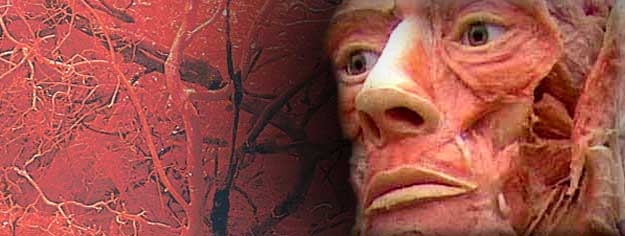
Not for the fainthearted ... Ever seen Plastination?


So very, very cool ... but to some may seem quite strange, quite quirky, quite gross. For others, quite impressive, sci-fi and indefinate. What is it .... the best way to describe it is to take the info from the Plastination History site: (P.S. Thre is an Anatomical Exhibition going on called Body Worlds 2)


In July 1977, while working as a scientist and research assistant at the University of Heidelberg’s Institute of Pathology and Anatomy, Dr. Gunther von Hagens had an outrageous notion. "I was looking at a collection of specimens embedded in plastic. It was the most advanced preservation technique then, where the specimens rested deep inside a transparent plastic block. I wondered why the plastic was poured and then cured around the specimens, rather than pushed into the cells, which would stabilize the specimens from within and literally allow you to grasp it."


The notion was an epiphany for Dr. von Hagens, and the genesis of Plastination — his groundbreaking invention where all bodily fluids and soluble fat from anatomical specimens are extracted to stop decomposition, and replaced through vacuum-forced impregnation with reactive resins and elastomers, such as silicon rubber and epoxy that harden with gas, light, or heat curing, giving the specimens rigidity and permanence.


Weeks later, while preparing serial slices of human kidneys for a research project, another thought occurred to him as he embedded the kidney slices in liquid plexiglass, and watched the air bubbles that resulted from stirring the hardener that had to be extracted under vacuum. "It crossed my mind that it would be possible to impregnate an acetone soaked renal piece with plastic under vacuum conditions simply by extracting the acetone in the form of bubbles, just as is done in degassing." Though many acetone bubbles were extracted from the specimen, it shriveled into a black mass within the hour.


But Dr. von Hagens was undeterred by the result of his maiden voyage into the world of Plastination. His basic knowledge of physics and chemistry enabled him to conclude that the black coloration stemmed from the refractive qualities of the impregnation process. This realization prompted him to repeat the experiment a week later using liquid silicone rubber that had more favorable light refractive properties. He administered the impregnation slowly, pouring fresh silicon in three separate baths to avoid premature hardening of the silicon and specimen from exposure to air. After curing the specimen in the open air, Dr. von Hagens held in his hands the world’s first plastinate.


In March of 1978, Dr. von Hagens filed a patent for his invention with the German Patent Office. However, he had only scratched the surface of Plastination. The refinement of his invention and the creation of the first whole body plastinate would take thirteen more years, though he declares even now that his methods are not yet perfect.


For more info check out these links:


Plastination Museum


As they say ..... "REST IN PLASTIC"


Monday, November 20, 2006

Austrailia's Life Art Coffins


Life Art Australia believes in celebrating and honouring people. I copied their "About us" page verbatim -- as it is written so well. And I like their style!


It is this generation who have challenged and rewritten the accepted norms. We have rewritten our wedding vows, rewrote our birthing ceremonies, and redefined the notion of family. Our generation rewrite every ritual that comes before us, and now we are considering the funeral ritual.


In recent years, there has been a definite change in the way we view funerals. Funerals are now viewed as “a celebration of life”. People are looking for more flexibility in how they conduct the ceremony, and are seeking to personalising the service to reflect the life of the individual.
This changing attitude created LifeArt Australia.The coffin is the central item of any funeral and probably the most symbolic. In today’s world of lifestyle choices and of environmental consciousness, people want the right to choose a coffin that reflects their values: from the ornate traditional, to the colourful personalised, to the modest environmental. LifeArt Australia has recognised two significant trends emerging in the Australian culture. The desire for:
the personalisation of funeral rituals - the demand for individualised funerals; - LifeArt Coffins and environmentally friendly coffins.- Enviroboard We see families creating their own traditions without fear of being "different”. We know it is the unique and personalised service that others remember.


We invite you to use our site as a resource to


  • View our range of designs

  • Learn about Enviroboard

  • See how to personalise your LifeArt Coffin

  • Reference our Personalisation collection to assist with ideas

  • Locate the funeral directors who supply LifeArt coffins

  • Enjoy reading and sharing stories and news

  • Participate in our surveys We will regularly be adding new designs and would welcome your feedback. We hope you come back to view our new images, read our stories and follow the developments to our LifeArt products.

We are proud to be an Australian company aiming to be recognised both locally and nationally as Australia's leading supplier of personalised and environmental coffin

Sunday, November 19, 2006

National Obituary Archive

Looking for an obituary? Looking for a celebrity obituary ... Check out The National Obituary Archive. I was looking for Elvis (just curiosity) and found Lionel Barrymore, Don Knotts and otehrs....

Saturday, November 18, 2006

SSA Death Index ... A Helpful Link

Social Security Death Index (SSDI)78,267,930 Records

Search the Social Security Death Index by entering one or more fields in the form and clicking on the "submit" button. Keep in mind that the more fields you fill in, the more restricted your results will be (and you may even eliminate the record you are seeking).

Friday, November 17, 2006

Abandoned Places . . .

Aeric Kane's Abandoned Places - evocative photographic images of sometimes strange and often haunted locations. Here you will find castles, stately homes, historic villages, cemeteries, churches and RMS Queen Mary - the greatest ocean liner that ever coursed the seas. Enjoy : )

Thursday, November 16, 2006

Grave Hunter ... Cool Gathering Place


Interested in Dead Celebrities? Visit Grave Hunter! This is pr

If you are looking to find the grave of dead celebrities or a final resting place of the infamous and a biography, you are in the right place!

Gone are the living, but the dead remain,
And not neglected; for a hand unseen,
Scattering its bounty like a summer rain,
Still keeps their graves and their remembrance green.
- Henry Wadsworth Longfellow's Epitaph

Wednesday, November 15, 2006

Obituaries 101 . . . Everything you need to find some one

Now this takes the cake ... Smart! Smart! Smart!

Finding an obituary just got easy. Visit Obituaries 101 and you can pretty much find any obit you need .... Search the USA & Canada Newspapers with the flick of a wrist. All you need is the Internet.

Nicely layed out -- by State ... and it looks like they have every newspaper out there listed!

Very cool indeed -- you should bookmark this one!